
Photos by Addiel Perera
The human body is perfect from a Creator’s point of view. It’s also complex. It takes an artist’s eye to bring it to light, with all its qualities and imperfections. Artist, author, and activist Mary Fisher is fascinated by it, especially by the human body’s burnt edges—where experiences and emotions rise to the surface like a memory cloth.
Fisher will be the first one to say, “I am that woman.” A successful artist with great passion, drive, and sensitivity, who doesn’t like to tell people what to see, what to think, or what to feel. For her, it’s more about what you see, what you feel, and how you experience it.
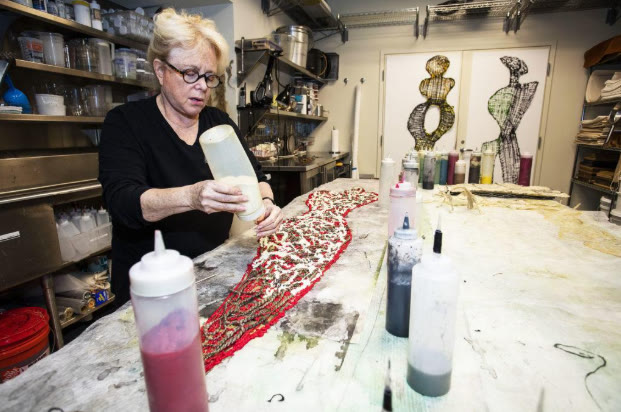
Mary Fisher working on her “Lifelines” Collection, symmetries of human forms put together with fabric, yarn, paint and a variety of threads.
Her next exhibit, properly titled “Textile Meditations: Mary Fisher & Friends,” will be the Armory Art Center’s first international textile arts show, opening on January 19 and running through February 10.
“Like Mary, her friends and fellow artists are also accomplished experts, authors, and instructors in their fields,” said Liza Niles, Chief of Exhibitions and Education at the Armory. “It’s exciting to be able to feature a show like this with such a particular diversity of work in textiles.”
Mary’s friends are no ordinary friends. They are artists Jan Beaney and Jean Littlejohn from London, and American artists Jane Dunnewold and Marsha Christo. The exhibition kicks off with an opening reception on Friday, January 19th, from 6:00 – 7:45 PM with Artist Talks from 7:00 – 9:00 pm. On Saturday, January 20th at 5:00 PM, Fisher will give a keynote speech entitled “Collaborative Creativity.” Two dynamic workshops are offered by the Armory Art Center and taught by Jane Dunnewold, Jan Beaney, and Jean Littlejohn on January 19-21, 2018. “The timing of this show, in which the artists explore textile construction from five perspectives, perfectly complements the recent expansion of our fiber department,” Niles said.
Before you attend the show, there’s something about Mary you need to know. This is a courageous woman who battled AIDS at a young age as a single mother. She not only lived to tell her story but also wrote books that have helped support the fight against the crisis. Fisher went to Washington to deliver an impactful speech, determined to be heard, and as a woman, that was not an easy feat. Drawing inspiration from her personal battle as an AIDS victim, as well as her works in media, including photography, sculpture, prints, beading, and fiber art, Fisher’s art is infused with texture and layers that evoke the beauty of life—both visually and spiritually.
The “Lifelines” Collection hangs from Mary Fisher’s studio in perfect sequence.
In 2015, the release of her fabric collection by Kravet/Lee Jofa Groundworks created a buzz in the market. Her designs, which feature superimposed organic motifs and intricate artisanal techniques, reflect her mixed-media approach. The collection is available exclusively in Lee Jofa showrooms around the world.
Fisher’s work, which has been featured in solo and group shows in major galleries around the world, is found in distinguished private and public collections in the United States and Europe and garners frequent mentions in art and mainstream media including The New York Times, Architectural Digest, The TODAY Show, People Magazine, Elle, Hand/Eye, Uppercase, More, Quilting Arts, The Quilt Life, art&culture, Adornment, Town & Country, and Textile.org.
Now, we invite you to go behind the scenes and get a sneak peek of Mary Fisher’s studio on S. Dixie Highway. This beautiful space was once an old building, with cracked, weathered walls and a sagging roof. In stepped Mary, fixing it and transforming it into her private oasis, where a new collection awaits the spotlight. And come January 19th, you will see and experience it for yourself.
No two pieces are alike. Here they are being transformed into something even the artist has yet to conceptualize.
MC: Mary, what inspires your art?
Partially, when I do my art, I don’t like to tell people what to see, what to think, or what to feel. Because for me, it’s more about what you see, what you feel, and how you experience it. Then we go into a communion together, because if it pulls you in, then I did my job.
MC: You have an incredible collection of art at your studio. You’re quite a busy lady.
MF: I can never keep my hands still. I’m one of those people who are constantly working with my hands.
MC: Your art is very intricate. What’s the most important part for you?
MF: The stitching is really important. Some of the things here might not have stitching in them, so they’re less expensive and don’t have the intensity or the longevity.
MC: And what’s this one called?
MF: This one’s called Threads of My Soul. And it’s a piece that started off as something I printed. Then I added organza and more stitching, and printed on it again. It evolved gradually as I worked on it.
MC: How long does it take you to create one of these pieces? From original concept to the finished product?
MF: You know, I never really plan much. I mean, I’m a pretty direct artist, I think. And I do sketch sometimes. I know my mentors would say, “You need to sketch more often.” But, if I’m sketching, then I might as well be making, right? Meaning, if I’m sketching, then I’m ready to make something. So this kind of piece, which is mostly stitching, evolves over time. It might take six months, or it might take one month if I were to just focus on that one. These are a little less time-consuming, because they’re pieces that I’m putting together for the “Lifeline” series.
It’s only because I work in pieces. See, I go from that piece, then to the next, etc.
MC: Are these part of the show? [Pointing to a series of different designs hung on the wall like a collage.]
MF: These are not part of the show, no. And they’re kind of a collage. Some are stitched, but there are some in here that aren’t part of their collection. It’s my experimentation with stitching and knitting, and things like that.
MC: So, when a customer buys one of your pieces, like the ones overhead, are they placed on a frame?
MF: These are the kind I would hang like that. There’s a piece behind it, which it’s on very thin paper. And on the back, there’s a printing—a sheet I’ve designed with dyed prints behind it, so the whole piece goes together, floating in mid air.
MC: This one looks interesting, it looks like a Sagittarius sign—half man, half horse.
MF: Does it? Hmmm. Well, there you go. See, that’s exactly what I’m talking about. I didn’t design it to be a Zodiac sign, but that’s how you’re interpreting it.
MC: Are these part of your new “Lifelines” Collection?
MF: No, but there are other kinds of Lifelines.
MC: But it’s got the same method…
MF: Yes, but it doesn’t have a grid; it’s more or less just doing its thing, see here? Now, this other one has silk that’s been dyed and printed on, then printed on again. And it’s got the paper on top, and then a grid on top of that.
MC: And what do the grids consist of? What texture is that?
MF: Well, it can be all different; it could be anything. But this is all threads. Threads with fabric. And I’ll show you some so that you can see. The work for the show is basically done, but then I can’t stop myself, so…
MC: Everything I see here is just remarkable. But my favorite pieces are those with burnt edges. What does that mean?
MF: What do you think it means?
MC: [Taking a moment to study the pieces closely.] It reminds me of a person’s vulnerability. Past hurts, frailties, and even failures, perhaps. Those areas in our lives that failed and burned a little bit of the person we were. [I look at areas with new threads.] But I see these areas that are new… like they’re trying to come out of those burnt edges, and that makes me think too. Like, when one goes through an incredible trial, and though we hurt, we prevail somehow. It could be spiritual growth, our faith. Hope. A new beginning, maybe.
MF: Hmm. [She smiles and places a gentle hand on my arm.]
Instantly, I felt a connection. Two human beings seeing and feeling something beyond words. As Mary turned to touch one of the piece’s burnt edges, I looked in her eyes, trying to capture the artist’s true meaning. Was I right? Was I on point? She never did say. But I like to believe that I got to see some bits and pieces—threads of her soul.