
[A MC | MAG play review.]
There is no perfect man, that much we know. And in Katori Hall’s The Mountaintop, which vividly reimagines the final night of Martin Luther King Jr.’s life, the playwright lifts the cloak of a saint to reveal an ordinary, flawed man with a dream to transform America into a loving, God-fearing nation.
The Mountaintop opened Palm Beach Dramawork’s 2025 – 2026 season last Friday night with a powerful performance by Christopher Marquis Lindsay [Dr. Martin Luther King, Jr.] and Rita Cole [Camae].
Fans of this award-winning play probably remember its premiere at Theatre503 in London in 2009, followed by a transfer to the West End, where Hall won the Olivier Award for Best New Play in 2010. It later opened on Broadway in October 2011 to critical acclaim, starring Samuel L. Jackson and Angela Bassett.
Hall is perhaps best known for her Broadway hit Tina: The Tina Turner Musical, based on the life of the iconic performer, which received two Tony Award nominations for her work as both playwright for “Best Book of a Musical” and producer in the “Best Musical” category. For the musical’s acclaimed West End production, she also received an Olivier nomination for “Best New Musical.”
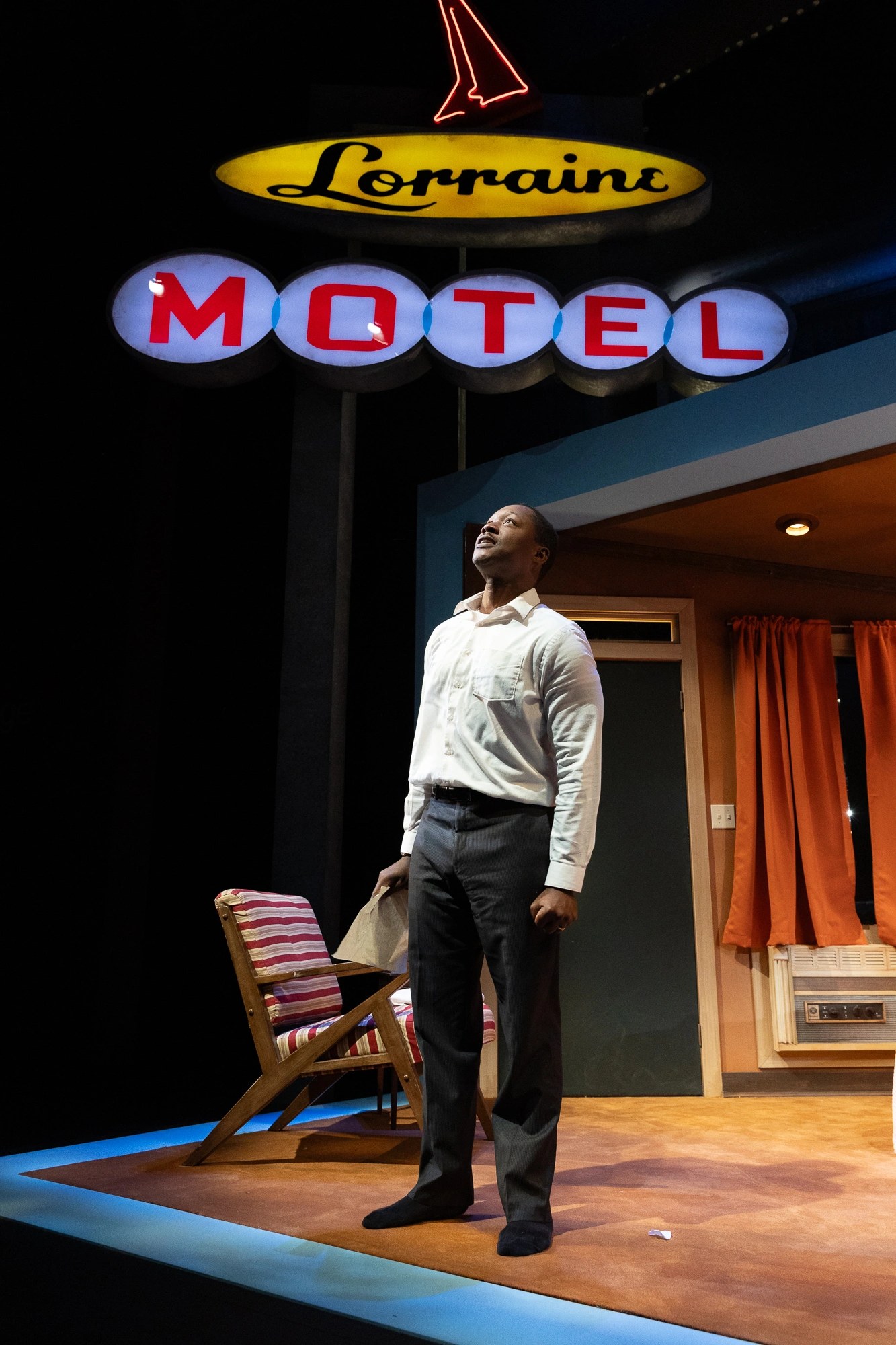
Directed by Belinda Boyd, The Mountaintop takes place in Room 306 at the Lorraine Motel on April 3, 1968, the day before King’s assassination. The set is stunningly beautiful, designed by Nikolas Serrano, with Roger Arnold's projection design moving the audience through the drama, especially during the ending scenes.
Throughout the play, King’s words underscore the importance of love, justice, and sacrifice, providing the audience with a grounding glimpse of his character—a figure cemented in American history through his pioneering efforts (and sacrifices) in the Civil Rights Movement. But before he became a hero and a martyr, leaving a legacy that achieved worldwide acclaim, honor, and reverence, King battled with very human vices. With the help of a beautiful, mysterious maid named Camae, we witness the final hours of this man in an inn not worthy of a king.
The Mountaintop could have been written solely as a drama, but it is the funny, heartbreaking scenes that speak loudest to the audience. Like the exchange between King and Camae when she lights up yet another cigarette and excuses herself after every curse word, or when she tries to impersonate him as she’s conducting a speech, donning his coat, and putting on his smelly shoes to finish the look. Or, when she’s trying to calm him down when his worst fears—being shot in the heart—take hold of him after a peal of thunder and lightning envelops the low-lit motel room, and sends him down to his knees, gasping for air.
But perhaps the scene that has the audience at the edge of their seats is when, in her effort to restore his equilibrium, Camae calls him by his Christian name, Michael, revealing that she is the Angel of Death sent to collect him. Heaven and hell are discussed at length in this particular scene, sending King on a spiral of thought that cross-examines what’s good and what’s evil—a question that’s left in the air for the audience to ponder.
It is in those scenes that Hall’s Olivier Award-winning play blends the everyday with the divine, captivating its audience with thought-provoking, deeply moving moments. Now, some theatergoers might perceive the portrayal of God and religion in this play as mocking. This reimagining is conveyed through the character of Camae, who questions the traditional power structures of the Black church, which were a cornerstone of King’s ministry.
Furthermore, Hall portrays God as a Black woman. Hall, who was raised in the Baptist church, has stated that she found her religious upbringing “patriarchal, sexist, and sometimes classist,” which influenced her unconventional interpretation of God.
There’s a powerful scene when Dr. King finally accepts his impending destiny and asks Camae to show him a glimpse of the future so he can see whether his work, lost love (his wife and kids), and sacrifice were worth it, and whether his successor—possibly Rev. Jesse Jackson, to King’s dismay—will carry the Civil Rights Movement forward. But, to his delight, he sees a flash of images that finally sets him at ease.
While the play is slow to start, the drama comes into its own and has a compelling ending. “Love is the only force capable of transforming an enemy into a friend,” said King in one of his famous speeches, and his words still have the power to resonate with this audience 57 years later.
The Mountaintop is playing at Palm Beach Dramaworks from October 24 to November 9. Get your tickets today!