
[As published in WPB Magazine]
In 1991, Neil Simon's remarkable play 'Lost in Yonkers' debuted at the Richard Rodgers Theatre on Broadway, boasting 780 performances. Now, thirty-four years later, it continues to captivate audiences, securing an extended run at Palm Beach Dramaworks.
There’s no better play to open Palm Beach Dramaworks’ new season and its 25th Anniversary than the Broadway king of one-liners—Neil Simon’s Pulitzer Prize-winning play “Lost in Yonkers.” This family comedy-drama pulls at the audience’s heartstrings as it beautifully tells the Kurnitz Family dynamics and generational conflict—a typical American immigrant’s story filled with laughs and drama.
Set in 1942, the story begins when Eddie Kurntz [Patrick Zeller] travels from his home in the Bronx to Yonkers, where he drops off his two sons, Jay, 15 [Will Ehren], and Arty, 13 [Victor de Paula Rocha], at his mother’s house. But as the boys quickly discover, this is not an ordinary visit but an extended stay.
Grieving the death of their mom and their dad’s impending sales business trip to get out of a loan shark’s $10,000 debt, which he used to pay for his wife’s medical bills, the boys look at their Grandma’s house in Yonkers, New York, as an alternate universe. Gone is their apartment in the Bronx, their everyday life with their friends back home, and any chance of having a fun summer. Suddenly, the heat of summer beats down on them, foreshadowing what’s to happen next.
After an awkward “kiss Grandma” scene, Jay and Arty reconnect with Grandma Kurnitz [Laura Turnbull], a stern and embittered Jewish-German immigrant whose complicated past made her harsh, cruel, and deceitful. But as the story unfolds, one can observe that she cleverly masks her pain and grief with anger, control, and an almost male-like bravado.
Against all odds, she is the family’s matriarch, having started the family business —a sweet-filled ice cream parlor. Still, nothing could combat her sour relationship with her children—a situation ripe with comedy and high drama, and as the boys will discover, a circle of family members who are loony or altogether frightening.
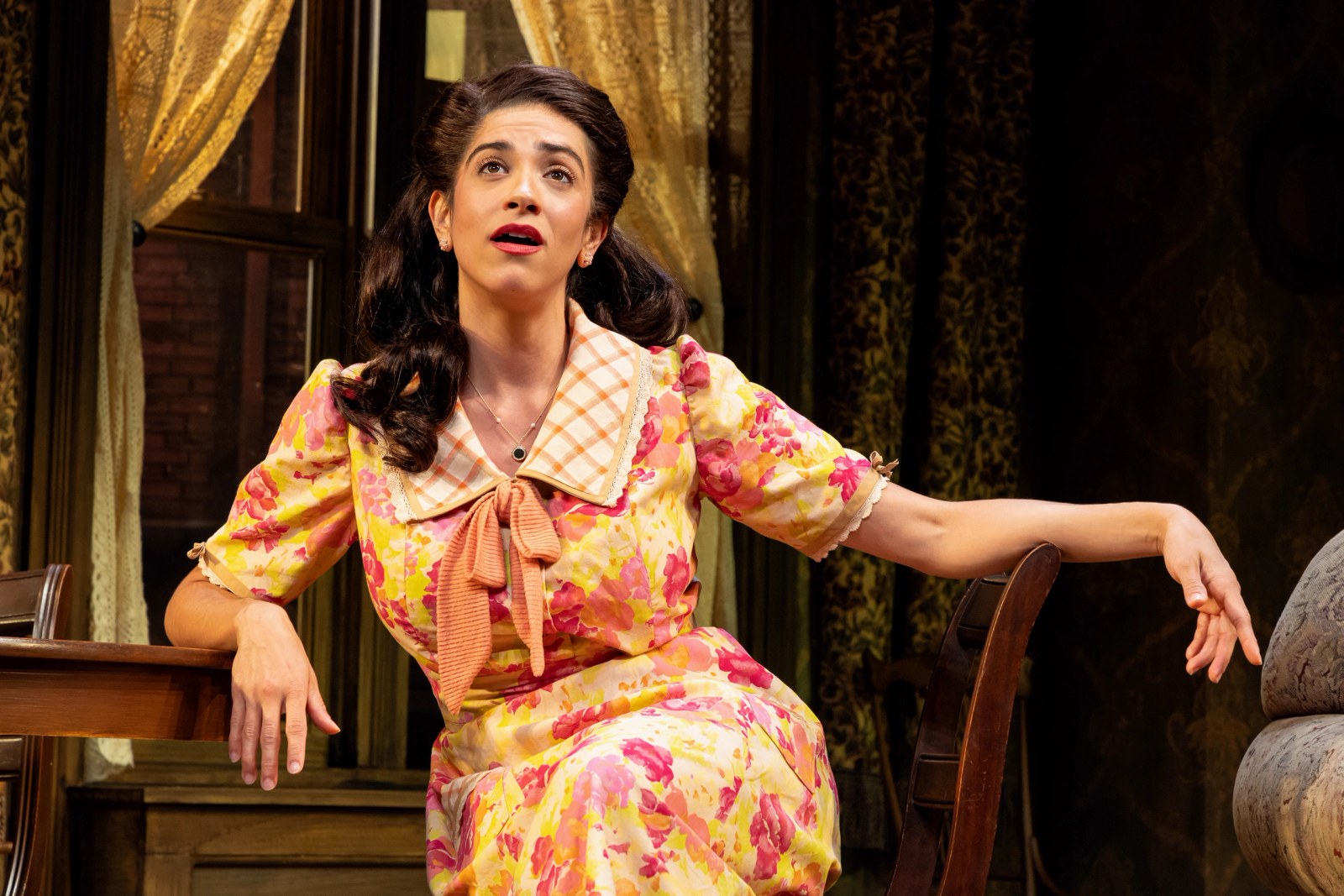
Their Aunt Bella [Fig Chilcott] is strange, and her mother has led her to believe that she is crazy, but Bella, as they will get to know well, doesn’t belong in an insanity ward; instead, she is certifiably a child lost in a woman’s body. Their Uncle Louie is involved with the mob and is on the run, carrying a duffel bag filled with their money. Aunt Gert [Suzanne Ankrum] is also a fruit of the Kurnitz’s eccentric family tree. Due to her mother’s stern love, she suffers from a breathing issue, which has developed into a nervous tic, causing her to exhale at the start of a sentence and inhale at the end. The condition is magnified tremendously when she is around her mother, so she tries to avoid her at all costs.
Director Julianne Boyd excellently exploits Simon’s classic play. She guides the cast through the love, pain, anger, frustration, and humor of the Kurnictz experience. She finds the talent necessary to make this play work in the Jay and Arty characters, powerfully played by Ehren and de Paula Rocha, who expertly navigate the drama, laughs, and mood swings that accompany adolescence’s awkwardness and growing pains.
In “Lost in Yonkers,” Simon writes an extraordinary story whose characters grow and mature, like Jay and Arty’s case, who won’t let Grandma get the best of them. But Bella surprises the audience as she takes the first steps toward maturity when confronting her mother with brilliant, heart-warming speeches. She attempts to move on with her adult life by becoming an independent woman despite her mental shortcomings and harsh upbringing. Ultimately, Bella is the story’s hero, changing her family and, most significantly, her mother’s heart.
First published in 1991, “Lost in Yonkers” is Simon’s best production. Like most of his plays, it draws from the playwright’s upbringing in New York City and his experiences as an immigrant, equally sad and humorous. The play was adapted into a 1993 film starring Richard Dreyfuss as Louie and Mercedes Ruehl as Bella.
When it was released on Broadway, the play was quite timely. Although the setting was World War II, the play’s narrative was relatable to America in 1991 when it entered the Gulf War in the Middle East. For that reason, the play’s central themes—survival, acceptance, and the importance of family—resonated deeply with American hearts.
In one particular scene in Act I, Bella confronts her mother when she refuses to take in the boys, as Eddie has requested. Eddie blows up and tells his mom that she doesn’t have a heart—why he has avoided visiting her for years and hasn’t seen the boys since they were babies. His mother’s decision is final. She won’t allow the boys to stay. Bella uncharacteristically stands up to her mother, threatening to leave home if she doesn’t let the boys stay. Her mother concedes, after all, she doesn’t want to be left all alone.
“Lost in Yonkers” is a timeless play that entertains its audience with Simon’s witty dialogue and dramatic scenes inspired by his childhood. At times, the story takes a dark turn, like most dramas do, but the bittersweet laughs light up the tone, making us more hopeful and whole, just like the characters in Neil Simon’s play.
—
‘Lost in Yonkers’ runs approximately two hours and 15 minutes with a 15-minute intermission. The production run has been extended to November 23, 2024. To purchase tickets, visit www.palmbeachdramaworks.org or call the box office at (561) 514-4042, ext. 2.